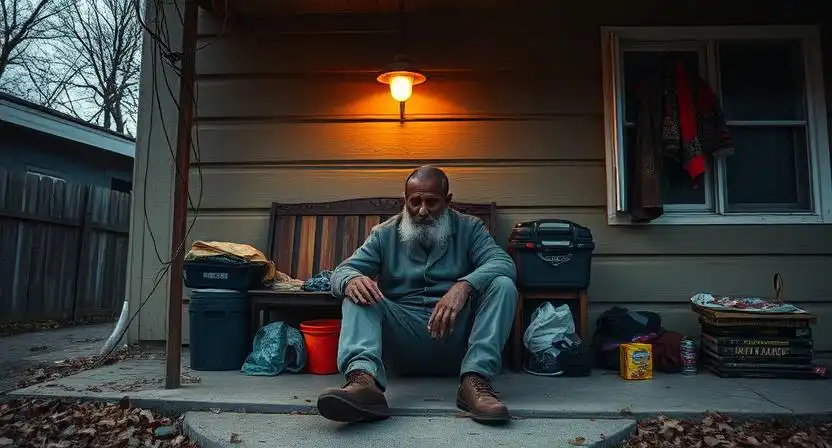
Homeless Guy in House Trend: When AI Pranks Cross the Line into Real-World Danger
Homeless Guy in House Trend is more than just a viral joke; it’s a disturbing case study in how accessible AI technology is outpacing our collective common sense. Imagine getting a text from your child: a hyper-realistic photo of a disheveled, distressed-looking stranger sitting in your living room, accompanied by a panicked voice note claiming this “homeless guy” just walked in.
The panic is instant, visceral, and very real. This is the core of the trend that has exploded on TikTok, leaving a trail of terrified parents and concerned law enforcement in its wake. But what starts as a seemingly harmless prank reveals a much darker side, raising critical questions about digital ethics, mental health, and the very nature of truth in the age of AI.
1. Deconstructing the Viral Panic: How the “Homeless Guy in House” Prank Works
The mechanics of the trend are simple, which is why it has spread like wildfire. Its power lies in its exploitation of fundamental human instincts: the fear of a home invasion and the innate trust we place in visual evidence and our own children.
The process typically follows these steps:

- AI Image Generation: A user employs an AI image generator (like Midjourney, DALL-E 3, or a similar mobile app). The prompt is something along the lines of: “A disheveled homeless man with torn clothes, sitting on a modern living room sofa, photorealistic, detailed, high resolution.”
- Crafting the Narrative: The AI produces a shockingly convincing image. The prankster then takes a screenshot or saves the image.
- The Delivery: The image is sent to a parent or family member via a messaging app like iMessage or WhatsApp. It’s often accompanied by a frantic voice message selling the story: “Mom, I don’t know who this is! He just walked in and said he knows you!”
- The Payoff (and Fallout): The recipient, faced with what appears to be irrefutable visual proof of a stranger in their safe space, reacts with pure fear. Reactions range from screaming and calling other family members to, in extreme cases, calling 911.
The trend’s virality is fueled by the “success” of these pranks, with reaction videos being shared back on TikTok for laughs. But the laughter masks a series of profound consequences.
2. Beyond the Laughs: The 5 Critical Real-World Consequences

This isn’t a victimless prank. The Homeless Guy in House Trend has tangible, dangerous outcomes that extend far beyond a moment of temporary fear.
1. The Dangerous Drain on Emergency Services
When a panicked parent calls 911 to report an intruder, it triggers a full law enforcement response. As seen in the case of a high school in Island County, Washington, where a similar AI-generated image of a homeless person caused a school-wide panic, police are forced to intervene. They must treat every threat as real until proven otherwise, diverting crucial resources from genuine emergencies.
2. The Lasting Psychological Impact
Being convinced, even for a few minutes, that your home—your ultimate sanctuary—has been violated can be a traumatic event. The adrenaline rush, the fear for your family’s safety, and the feeling of helplessness can lead to lingering anxiety, sleep disturbances, and an eroded sense of security. It’s a cruel emotional manipulation.
3. The Erosion of Trust Within Families

Trust is the foundation of any family. A prank that deliberately incites terror in a parent fundamentally betrays that trust. The moment the “gotcha” is revealed, the dynamic shifts. The parent feels foolish and violated, while the child may not grasp the severity of their actions. This can create lasting resentment and make parents skeptical of future, potentially real, emergencies their children report.
4. The Insulting Stereotyping of Vulnerable Populations
The trend casually uses the image of a “homeless man” as a default symbol for danger and intrusion. This reinforces harmful and dehumanizing stereotypes about a vulnerable segment of our society. According to the U.S. Department of Housing and Urban Development (HUD), hundreds of thousands of Americans experience homelessness, and the vast majority are not violent intruders. This trend unjustly stigmatizes them for a cheap laugh.
5. The Acceleration of Reality Collapse
When hyper-realistic fakes can be created by anyone with a smartphone, it becomes increasingly difficult to trust what we see. This “reality collapse” has dire implications for everything from personal relationships to public discourse and legal proceedings. The Homeless Guy in House Trend is a training ground for the kind of misinformation that can destabilize communities.
3. The Tools Behind the Trick: A Look at Accessible AI Generators
The prank’s viability hinges entirely on the stunning quality of modern AI image generators. Just a year ago, such a convincing fake would have required a skilled Photoshop artist. Today, it’s accessible to any teenager.
- Midjourney: Known for its artistic, photorealistic outputs that are often indistinguishable from photographs.
- DALL-E 3 (via ChatGPT): Excels at understanding complex prompts and generating coherent, detailed scenes.
- Stable Diffusion: An open-source model that can be run locally or through various apps, offering immense customization.
These tools are not inherently bad; they are powerful instruments for creativity and innovation. However, the Homeless Guy in House Trend is a prime example of their potential for misuse when ethical guidelines are ignored.
For those interested in using AI for creative projects ethically, consider exploring the resources and software available on Amazon. (This is a placeholder for an integrated Amazon Affiliate link to a book on AI ethics or a creative software subscription).
4. How to Protect Yourself and Your Family from AI-Powered Pranks
In this new digital landscape, a healthy dose of skepticism is a necessary form of self-defense. Here’s how you can spot a fake and maintain your cool.
- Look for Digital Artifacts: Examine the image closely. Are the hands slightly off? Is the lighting inconsistent? Do the eyes look unnaturally glassy or aligned? AI often struggles with fine details.
- Check for Context: Does the story make sense? Why would your child be calmly taking a picture instead of calling for help or running away?
- Verify Instantly: The simplest solution is to video call the person who sent the image. A live video feed is much harder to fake in real-time and will immediately debunk a static image.
- Educate Your Family: Have an open conversation about this specific trend. Explain the serious consequences and the harm it causes. Frame it not as a “don’t you dare” rule, but as a lesson in digital citizenship and empathy.
5. The Bigger Picture: AI, Ethics, and the Law
The Homeless Guy in House Trend is a canary in the coal mine. It forces us to confront the legal and ethical gray areas of AI.
- Is it Illegal? Currently, creating a fake image is not typically illegal on its own. However, the actions that follow can be. Wasting police time, inciting panic, or causing emotional distress can have legal repercussions. Law enforcement agencies, like the FBI, are developing units to tackle digital misinformation and cyber-enabled crimes.
- The Platform’s Responsibility: Social media platforms like TikTok face mounting pressure to moderate this type of harmful content more proactively. While they ban content that causes “serious harm,” the enforcement is often reactive rather than preventive.
This trend is a wake-up call. We need a societal conversation about digital ethics, starting in our homes and schools, to ensure that our technological capabilities are matched by our wisdom in using them.
Frequently Asked Questions (FAQ)
Q1: What should I do if I receive a “Homeless Guy in House” prank text?
Stay calm. Do not panic. Immediately video call the person who sent it to verify the situation. Look for digital artifacts in the image. Remember that this is a known viral trend.
Q2: Can the people making these AI images get in trouble?
Yes. If the prank leads to a 911 call, the prankster could be charged with filing a false police report, misusing emergency services, or disorderly conduct. Schools have also disciplined students involved.
Q3: What AI tools are people using to create these fake photos?
The most common tools are Midjourney, DALL-E 3 (accessed through ChatGPT), and various apps powered by Stable Diffusion.
Q4: How can I talk to my kids about the dangers of this trend?
Have an open, non-accusatory conversation. Explain the real-world consequences: the fear it causes, the drain on police, and the damage to trust. Encourage them to use their tech skills for creative and positive projects instead.
Source: Wiz Techno + websites