
AI Mood Programming: How Emotion AI Is Changing Software Development
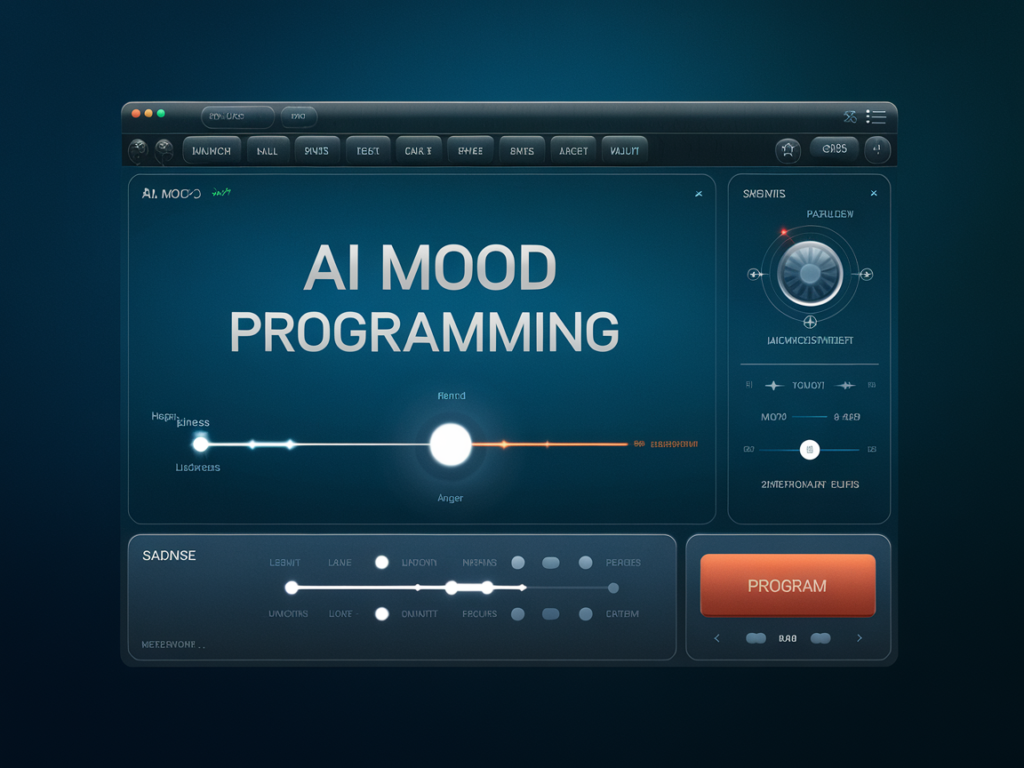
AI Mood Programming is emerging as one of the most intriguing innovations in the software development world. By leveraging Emotion AI, this new paradigm allows AI tools to understand a programmer’s intentions, moods, and preferences — transforming abstract ideas into executable code.

In the past, coding required precise syntax and meticulous attention to logic. Today, developers and designers can communicate their concepts naturally, letting AI translate ideas into functioning programs. This approach is faster, more intuitive, and opens programming to a broader audience.
What Is AI Mood Programming?
AI Mood Programming combines natural language processing, emotion recognition, and AI-driven code generation. Unlike traditional programming, where developers must write exact commands, this approach interprets user instructions along with contextual signals like mood, intent, and stylistic preferences.

For example, a user might describe a function as “friendly and intuitive” or “strict and formal,” and the AI interprets these cues into code structure and design patterns. This is made possible by large language models (LLMs) trained on millions of code snippets and emotional datasets.
From Traditional to Mood-Based Programming
Traditionally, programming involved interpreting rigid syntax and executing precise instructions. Errors were common, and projects required substantial time and effort. With AI Mood Programming, the process becomes iterative and collaborative:
- The human provides a natural language description.
- AI generates initial code snippets.
- The human reviews, tweaks, or re-describes requirements.
- AI refines and produces executable code.
Tasks that once took days or weeks can now be achieved in hours, especially for prototyping and generating repetitive patterns.
How Emotion AI Works in Coding

Emotion AI models analyze multiple layers of human input:
- Linguistic style: Formal, informal, simple, or complex.
- Contextual history: Past coding patterns and preferred frameworks.
- Mood detection: Inferring stress, creativity, or an exploratory mindset.
- Behavioral cues: Optional voice tone, keystroke rhythm, or documentation style.
By combining these signals, AI can generate code aligned with the programmer’s intent, reducing mismatches between expectation and implementation.
Key Benefits of AI Mood Programming
- Accelerates Development Cycles: AI handles repetitive code, allowing humans to focus on high-level design.
- Reduces Errors: By interpreting intent and context, AI can prevent common mistakes like type mismatches or logic errors.
- Democratizes Programming: Non-programmers can participate in software creation through natural language descriptions.
- Enhances Creativity: Programmers can experiment with ideas without worrying about syntax constraints.
- Customizable Outputs: AI adapts to individual coding style and project requirements.
This technology empowers startups, designers, and solo developers to prototype faster and explore more complex applications without extensive coding knowledge.
Challenges and Limitations

Despite its promise, AI Mood Programming faces hurdles:
- Interpretation gaps: AI may misread emotions or stylistic cues, leading to unexpected code.
- Cultural and linguistic biases: Variations in language or expression can produce inconsistent results.
- Collaboration issues: In teams, different moods and styles may conflict, requiring human moderation.
- Testing and validation: There’s a lack of standardized methods for verifying AI-generated code based on mood.
Ultimately, AI Mood Programming is an assistant, not a replacement, for developers. Understanding its limitations ensures effective and safe use.
Real-World Applications
- Rapid Prototyping: Quickly generate app frameworks or modules based on design briefs.
- Game Development: Translate descriptive narratives (“heroic, fast-paced combat”) into functional game logic.
- UI/UX Tools: Generate user interface components aligned with aesthetic and emotional goals.
- Educational Platforms: Help students or non-technical users write code by expressing goals in plain language.
Many companies are already experimenting with AI Mood Programming to accelerate time-to-market and reduce development costs.
Comparison: Traditional Coding vs AI Mood Programming

| Aspect | Traditional Coding | AI Mood Programming |
|---|---|---|
| Speed | Moderate to Slow | Fast (prototyping in hours) |
| Accessibility | Developer-only | Open to non-programmers |
| Error Handling | Manual debugging | AI-assisted error prevention |
| Creativity | Limited by syntax | Enhanced by natural expression |
| Collaboration | Code-centric | Context & mood-aware |
This comparison highlights how Emotion AI is reshaping software workflows and reducing barriers to innovation.
Tools & Platforms Supporting AI Mood Programming
- GitHub Copilot X: Integrates AI code suggestions directly into IDEs.
- OpenAI Codex: Converts natural language into multiple programming languages.
- Replit Ghostwriter: Offers contextual AI assistance for coding in real time.
- Tabnine: AI-powered code completions with adaptive learning.
For experimentation and learning, you can also try personal AI coding assistants available online.
Affiliate Suggestion:
🔗 AI Coding Tools for Beginners: Simple Strategies for Smarter Workflows and Better Code — Ideal for students and professionals exploring AI-driven programming.

Future Outlook
The rise of AI-driven mood programming signals a shift toward human-centered coding, where tools adapt to the programmer rather than the other way around. Experts predict:
- Increased adoption in startup environments and prototyping labs.
- Greater accessibility for non-technical professionals to contribute to software projects.
- Emergence of standards and evaluation metrics for AI-generated code.
- Integration with AI-driven project management tools for smoother workflows.
By 2026, AI Mood Programming may become a standard part of the developer toolkit, not just an experimental feature.
FAQs
Q: Can non-programmers really create functional software with AI Mood Programming?
Yes. AI can translate plain language instructions into working code for simple applications and prototypes.
Q: Is this method suitable for large enterprise software?
It’s useful for prototyping, generating boilerplate code, and iterative development, but human oversight remains crucial for complex, mission-critical systems.
Q: Does AI Mood Programming replace programmers?
No. It enhances productivity, creativity, and accessibility, but cannot replace the strategic thinking, architecture planning, and debugging expertise of human developers.
Q: How is privacy handled in Emotion AI coding tools?
Top platforms anonymize user inputs and comply with data protection regulations; however, users should review their privacy policies before sharing sensitive project information.
Internal Links (for Wiztechno.com)
- Copilot’s Voice Expressions: The Shocking Leap Making Microsoft’s AI Voices Sound Truly Human
- How AI Tempts People to Commit Suicide: 5 Shocking Findings That Expose Critical Risks
- AI Agents Practical Uses: 7 Powerful Real-World Benefits Transforming Work and Life
External References
- Statista: AI Adoption in Software Development
- Pew Research: AI in the Workplace
- OpenAI: Codex Documentation
Final Thoughts
AI Mood Programming is revolutionizing how humans interact with code. By blending emotion recognition and advanced natural language processing, it empowers developers, designers, and even non-technical professionals to bring ideas to life faster than ever before.
While challenges remain — particularly in collaboration, consistency, and validation — the potential for faster prototyping, reduced errors, and enhanced creativity is undeniable. As tools and standards evolve, Emotion AI will become a key driver of efficiency and innovation in software development.
This approach isn’t a shortcut; it’s a powerful addition to the developer’s toolkit, enhancing capabilities, accelerating workflows, and opening programming to a wider audience.
Source: WizTechno.com + external tech reports